Cebra
A machine learning algorithm for creating interpretable embeddings from neural and behavioral time-series data.
| What is it | A machine learning algorithm for creating interpretable embeddings from neural and behavioral time-series data. |
|---|---|
| Pricing | Unknown |
| Platform | Web Application |
| Best for | decoding neural activity patterns, analyzing behavioral data |
| Domain registered | 2022 |
Data updated Sept. 19, 2026
What does Cebra do?
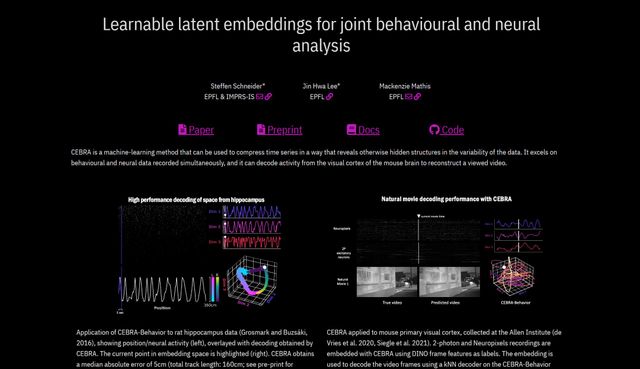
Cebra is a specialized machine learning algorithm designed to compress and analyze time-series data, particularly focusing on neural and behavioral recordings. It creates interpretable embeddings that reveal hidden structures in complex datasets, making it especially valuable for neuroscience research where scientists need to map behavioral actions to neural activity patterns. The tool excels at processing high-dimensional data from various recording methods including calcium imaging and electrophysiology.
What sets Cebra apart is its flexibility in operating modes—it can work in both supervised (hypothesis-driven) and self-supervised (discovery-driven) approaches. Researchers have demonstrated its effectiveness across multiple species and experimental setups, from decoding viewed videos from mouse visual cortex activity to reconstructing movement trajectories from primate sensorimotor cortex data. The algorithm produces consistent latent spaces that maintain their structure across different sessions and recording modalities.
Neuroscience researchers and machine learning specialists working with time-series data will find Cebra particularly valuable. It's been successfully applied to decode position during animal navigation, analyze complex kinematic features, and map neural representations of natural movies. The tool has been validated through peer-reviewed publications in top journals and is actively used in academic research settings for understanding neural dynamics and behavioral correlates.
Key features
What makes it stand outWho is Cebra for?
Who benefits most from this toolTrust & presence
Alternatives in Research Tool
 Acade
Verified
Research Tool
Acade
Verified
Research Tool
AI research assistant that maps literature, proposes testable hypotheses, and creates traceable reports.
 BioReason-Pro
Verified
Research Tool
BioReason-Pro
Verified
Research Tool
AI tool that generates functional summaries, reasoning traces, and literature-backed annotations for any protein sequence
 Tosea AI
Verified
Research Tool
Tosea AI
Verified
Research Tool
AI tool that turns academic PDFs into presentation slides by extracting figures and building outlines.
 pharma.ai
Verified
Research Tool
pharma.ai
Verified
Research Tool
AI drug discovery platform for target identification, molecule design, and clinical trial prediction
 Google Research
Verified
Research Tool
Google Research
Verified
Research Tool
Explore Google's latest publications, blog posts, and real-world AI research projects like Earth AI and Wildfire detection
 Research Topics Generator
Verified
Research Tool
Research Topics Generator
Verified
Research Tool
AI tool that helps researchers and students discover meaningful academic research topics based on their interests
 CitationGenerator.AI
Verified
Research Tool
CitationGenerator.AI
Verified
Research Tool
Free tool to instantly generate and format bibliographies, citations, and reference lists in APA, MLA, Chicago, and more.
 AcademicGPT
Verified
Research Tool
AcademicGPT
Verified
Research Tool
AI-driven platform for accelerating academic writing — upload research papers and generate sections like abstracts.
Similar tools
 Cerebro
Verified
Knowledge Management
Cerebro
Verified
Knowledge Management
AI-powered knowledge management — ask questions about your saved videos, articles, and PDFs to get instant answers with sources.
 Cerebras
Verified
AI inference
Cerebras
Verified
AI inference
Cerebras’ third-generation wafer-scale engine (WSE-3) is the fastest AI processor on Earth. It surpasses all other processors in AI-optimized cores, memory speed, and on-chip fabric bandwidth.
 Unforgettable
Verified
Research
Unforgettable
Verified
Research
Research platform that combines big data from 600+ sources with surveys to analyze human behavior
 Embra
Meeting Assistant
Embra
Meeting Assistant
AI meeting assistant that records, transcribes, and creates actionable notes with automated follow-ups
 XEBO.ai
Verified
For Data Analytics
XEBO.ai
Verified
For Data Analytics
AI-powered experience management platform — create smart surveys, analyze feedback, and get actionable insights from text and video.
 Sieve
Video
Sieve
Video
High-quality video datasets for AI training — curated, indexed, and searchable video data for machine learning applications.
 Abaka
Verified
Synthetic Data
Abaka
Verified
Synthetic Data
AI data annotation platform — provides human-labeled datasets and tools for training machine learning models.
 DataBrain
Verified
For Data Analytics
DataBrain
Verified
For Data Analytics
Embed AI-powered analytics dashboards into your product — users can chat with their data to get insights instantly