
Hypertune
Type-safe, Git-based feature flags, experimentation, and app configuration for TypeScript, React, and Next.js teams.
| What is it | Type-safe, Git-based feature flags, experimentation, and app configuration for TypeScript, React, and Next.js teams. |
|---|---|
| Pricing | Freemium — from $10/mo |
| Free tier | Yes |
| Platform | Web Application |
| API | Yes |
| Best for | gradual feature rollouts, A/B testing experiments |
| Domain registered | 2002 |
Data updated Sept. 19, 2026
What does Hypertune do?
Hypertune is a platform for managing feature flags, A/B tests, and application configuration. It lets development teams control which users see new features, run experiments, and change app behavior without deploying new code. Everything is managed through a central dashboard and integrated directly into your codebase with a type-safe SDK. This means you can turn features on or off for specific users, roll out changes gradually, or test different variations with real users.
The tool stands out with its deep integration for modern TypeScript-based stacks. It generates a type-safe client from your flag definitions, so your IDE can catch errors before runtime. It uses a custom, functional language called Hyperlang for writing targeting rules, and all configuration is version-controlled with Git. This provides a full commit history, branching, and pull requests for your feature flags, similar to how you manage code. It also supports local evaluation, so flag checks happen without network calls, keeping your app fast.
Hypertune is built for engineering teams using TypeScript, React, and Next.js. It's particularly useful for developers and product managers who need to deploy features safely, marketers who want to run targeted campaigns, and anyone managing complex application configuration. Use cases include gradually rolling out a new UI, running an A/B test on a pricing page, or enabling a feature only for users in a specific company or plan.
Key features
What makes it stand outWho is Hypertune for?
Who benefits most from this toolPricing
Free tier available — start without a credit cardFree
- 1,000,000 CDN requests
- 3 team members
- 1,000,000 analytics events
- 1m CDN requests
- 1m analytics events
- Up to 3 team members
- Unlimited CDN bandwidth and service connections
- Unlimited MAUs / MTUs
- Unlimited environments and projects
- Unlimited feature flags and experiments
- Type-safe, Rust-powered SDKs in all major languages
- Git-based version control
- Hypertune Toolbar to override flags from your frontend
- Integrations with Vercel Edge Config, the Vercel Toolbar, and the Flags SDK
- Flag debugger
- SSO via Google
Starter
Everything in Free, plus:
- Branches to test flag changes and support old app versions
- Pull requests to review, discuss, and merge branches
- Schema migrations
- Flag labels
- Webhooks
Pro
Everything in Starter, plus:
- Team roles and approval workflows
- Granular flag permissions
- Advanced experiment analysis
- Sequential testing
- Dedicated Slack channel
Enterprise
Everything in Pro, plus:
- Custom CDN requests
- Custom analytics events
- AI loops for automated experimentation
- Git repo with bidirectional sync
- API to make flag changes
- Bulk user management
- Warehouse-native implementation
- Self hosting
- Air-gapped environments
- Customer success manager and guided onboarding
- Enterprise SLAs
- Roadmap acceleration
- SAML 2.0 SSO
- HIPAA compliance and BAA
Trust & presence
Gallery
Click any image to enlargeSimilar tools
 Reflag
Verified
Developer Tools
Reflag
Verified
Developer Tools
Feature flag management for TypeScript devs — self-cleaning flags, agent integration, and local evaluation.
 Retune
Verified
AI Agent
Retune
Verified
AI Agent
No-code platform to build and deploy custom AI chatbots and autonomous agents for your business.
 BetterTyped
Verified
Developer Tools
BetterTyped
Verified
Developer Tools
Type-safe API layer for TypeScript apps — generate fully typed SDKs from OpenAPI specs for REST, GraphQL, WebSockets, and Firebase.
 Webtune AI
Verified
SEO Tools
Webtune AI
Verified
SEO Tools
AI-powered website maintenance tool that automatically identifies and fixes SEO issues across any CMS platform.
 Lightrun
Verified
Developer Tools
Lightrun
Verified
Developer Tools
AI-powered production debugging platform — add logs and snapshots to running applications without code changes or redeploys
 The New GitBook
Verified
Writing Assistants
The New GitBook
Verified
Writing Assistants
GitBook began in mid-2014 as an open-source tool for developers to build documentation. Today it gives teams the tools to create create beautiful, AI-optimized docs that automatically adapt to your users and drive conversion
 Genval
Verified
Developer Tools
Genval
Verified
Developer Tools
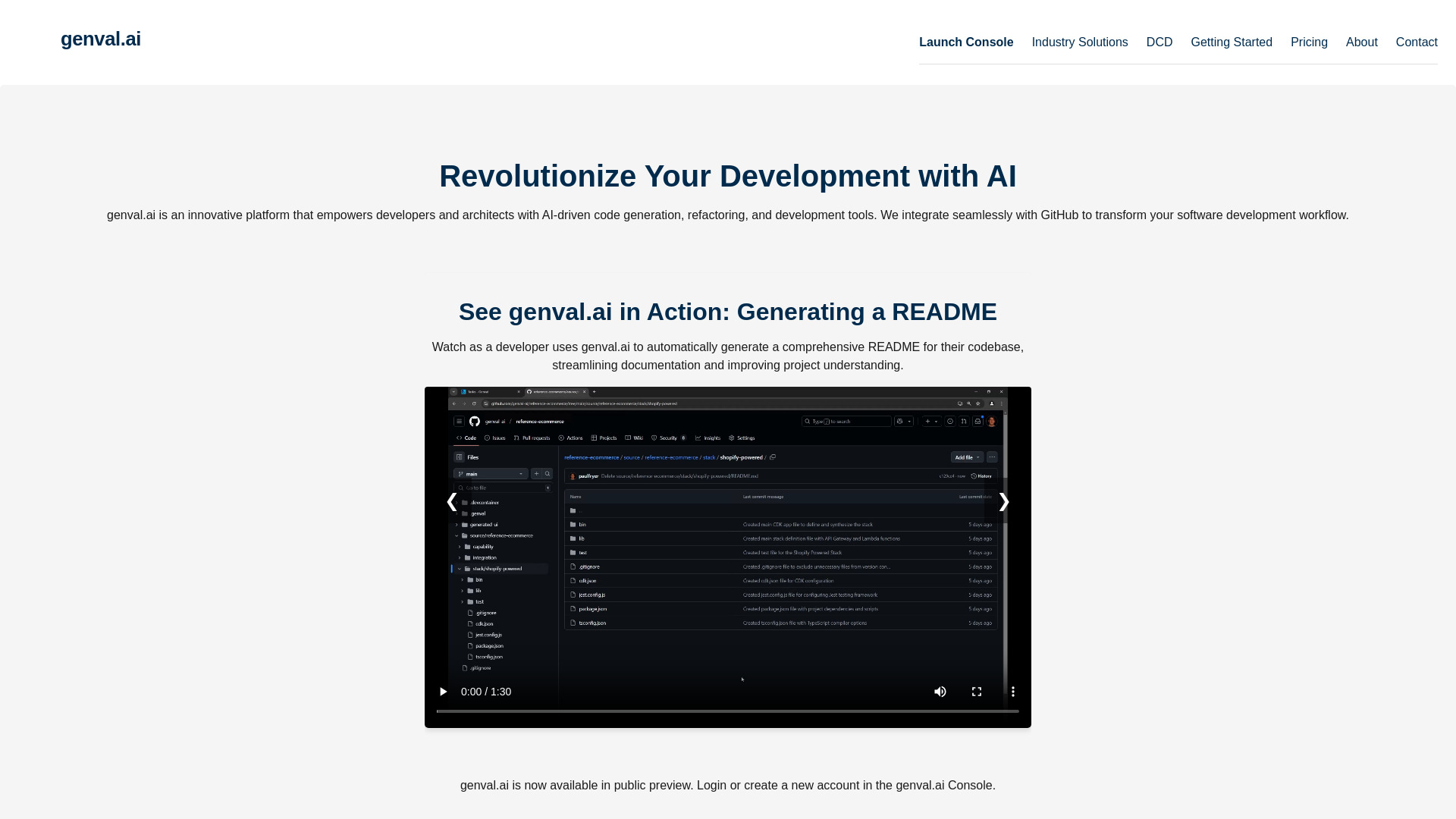
AI-powered code generation and refactoring tool — transform entire codebases with single prompts
 UserWatch
Verified
For Data Analytics
UserWatch
Verified
For Data Analytics
AI product analyst that sets up A/B tests, creates dashboards, and analyzes user session replays automatically.